

Digital ID in the UK: How Fear, Convenience & Crisis Create Consent (with Gareth Icke)
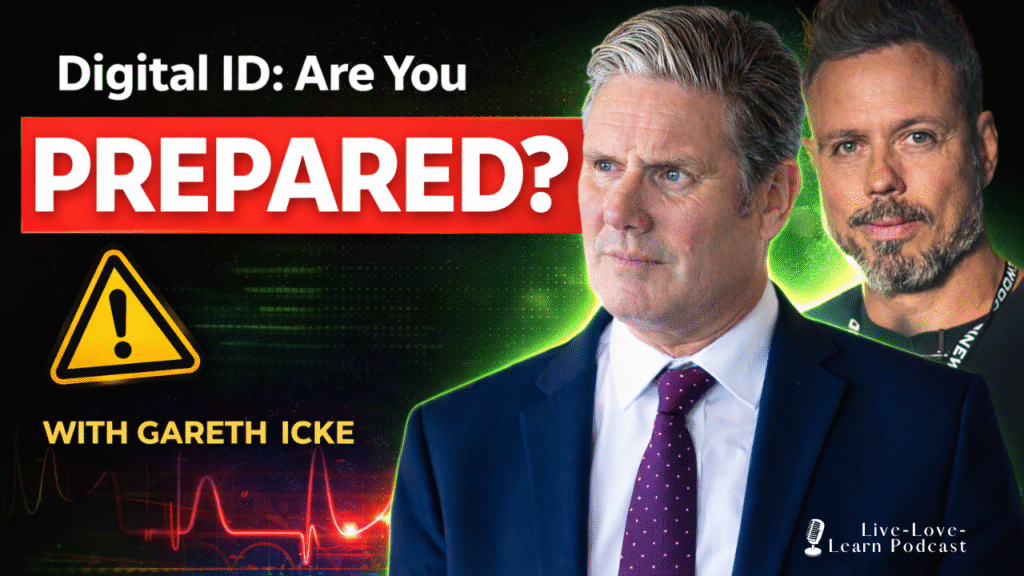
Digital ID, surveillance and sovereignty — Live Love Learn Podcast with Gareth Icke
Start here…
If you’ve landed here for the first time, welcome.
The Live Love Learn Podcast explores the bigger picture behind health, freedom, and modern life. I speak with guests from all over the globe who question mainstream narratives and look at root causes, not quick fixes, always with the intention of empowering people rather than alarming them.
These conversations aren’t about doom or drama. They’re about clarity, resilience, and remembering that we have more agency than we’re often led to believe.
Take what resonates, leave what doesn’t, and most of all stay curious.
Digital ID UK: Fear, Crisis & Consent with Gareth Icke
I loved this episode, as Gareth brings truth with a great mix of humour – we all need that when looking at topics that can seem ‘too hard to handle’. I hope this episode will help you make sense of what you’re already feeling. With so many distractions, are we being deliberately steered away fro looking too closely at Digital ID? I think so…
In this episode, I’m joined again by Gareth Icke, musician, presenter, writer, and co-founder of the independent platform Ickonic, for a grounded, wide-angle conversation about digital ID in the UK, mass surveillance, and the psychological strategies that often sit beneath major policy shifts. What I appreciated about speaking with Gareth is that he doesn’t just focus on what might be coming; he explains the mechanism that gets people to accept it in the first place, which is often far more important than the headline itself.
Digital ID rarely arrives in a calm, rational atmosphere where everyone has time to read the small print and weigh the long-term implications – and thats by design. More often, it shows up through confusion, fear, pressure, and the constant “breaking news” feeling that keeps the nervous system on edge. When you’re living in that state, it becomes surprisingly easy to give up pieces of freedom without realising you’ve done it – please check out this Blog with Jason Christoff for more on that! .
What we explore in this episode
In this conversation, we talk about why digital ID often becomes politically possible through crisis, rather than through healthy debate, and how emergency legislation has a way of moving far faster than the public ever would if they were calm and thinking clearly. We also discuss the quieter infrastructure that gets built in the background: data legislation, privacy rollbacks, “gateway” systems, biometric adoption , because even if people are loudly resisting digital ID as a single policy, it’s often the smaller changes that make it workable later.
We touch on the way divides are deliberately encouraged (left vs right, native vs immigrant, faith vs faith), not because those divisions are new, but because they’re effective. A fragmented population is much easier to steer than one that is united, informed, and emotionally regulated. And we speak about the reality that many people are “waking up”, which is encouraging, but that the people who want digital ID don’t only rely on persuasion; they also rely on creating conditions where people feel they have no choice.

The real sales pitch is rarely control…it’s convenience
One of Gareth’s strongest points is that these systems don’t always arrive as a blunt force, and they don’t always feel oppressive at first. Quite often, they come packaged as a “helpful upgrade” that seems to solve real problems in people’s day-to-day lives: cheaper fares, easier access, smoother travel, faster transactions, fewer forms, less friction.
That is exactly why it’s so effective.
When your phone becomes your ticket, your wallet, your identity, and your access key, the system doesn’t have to control you with obvious threats; it can simply shape the environment around you and gradually remove the opt-out. This is why people can feel like they’re “winning” because something isn’t officially compulsory, while the infrastructure is being built quietly through pilot schemes, app rollouts, and “optional” sign-ups that later become the default.
And the uncomfortable truth is that convenience can make people accept things they would normally reject, especially when money is tight, time is scarce, and life feels heavy enough already.
Fear changes behaviour, and that’s the point
A big part of this episode is the psychology of compliance, and Gareth gives a simple example that makes it instantly clear: if you can put someone into even a mild state of panic, they’ll often hand over something they wouldn’t normally hand over , not because they’re stupid, but because the mind prioritises speed and safety over critical thinking when it senses threat.
That’s why constant crisis messaging works. When people are flustered and overwhelmed, they stop asking deeper questions and start searching for the quickest way to feel safe again. They don’t just accept new measures; they sometimes begin requesting them, because they want the anxiety to stop. Once you understand that, it becomes much easier to see how “breaking news”, terror narratives, and the never-ending sense of instability can be used to manufacture consent for systems people would otherwise refuse. Again, check out my Episodes (also available on your favourite Podcast Platforms) with Mind Control Expert Jason Christoff (CLICK HERE) .
Even if you disagree with parts of this conversation, the core insight is worth sitting with: humans behave differently under fear, and fear is one of the most reliable levers for pushing society in a particular direction.
What do we actually do with this?
I don’t want anyone reading this to feel hopeless, and that isn’t the energy of this episode either. If anything, it’s a reminder that we’re not powerless, but we do have to be honest about how easily humans can be nudged when we’re tired, isolated, stressed, and constantly online.
We talk about the importance of staying emotionally regulated, not because it’s a spiritual nice-to-have, but because a regulated nervous system gives you back your discernment. We also speak about stepping out of the noise, making space for humour, getting outdoors, reconnecting with people and with life, and building local resilience where you can, because burnt-out people don’t resist effectively, and exhausted communities don’t stay united for long.
And then there’s the simplest point, but it might be the most important: learning to say no clearly, without leaving an escape hatch.
Not “I won’t do it unless…”
Not “I won’t, but…”
Just no.
Because the moment you add “unless,” you’re showing the system exactly which pressure point to push.
A few lines that stayed with me
-
Convenience is the killer of freedom.”
-
“If you’re frightened, you’ll accept what you’d never accept normally.”
-
“Say no, and mean it. Don’t add the ‘unless’.”
-
“It’s going to be fine. There are more of us than there are of them.”

Listen to the full episode (please do leave a comment or review if any of my episodes responate)
🎧 Listen here:
-
Spotify: Listen/watch here
-
Apple Podcasts: Listen here
-
YouTube: Watch here
If this episode resonated, please share it with someone who you know is quietly questioning things but doesn’t quite have the language for it yet. It genuinely helps the show reach new people, and it helps me bring in guests who are willing to speak openly, thoughtfully, and calmly about what’s happening, and how we stay human inside it.
Stay curious, and stay free 😊