
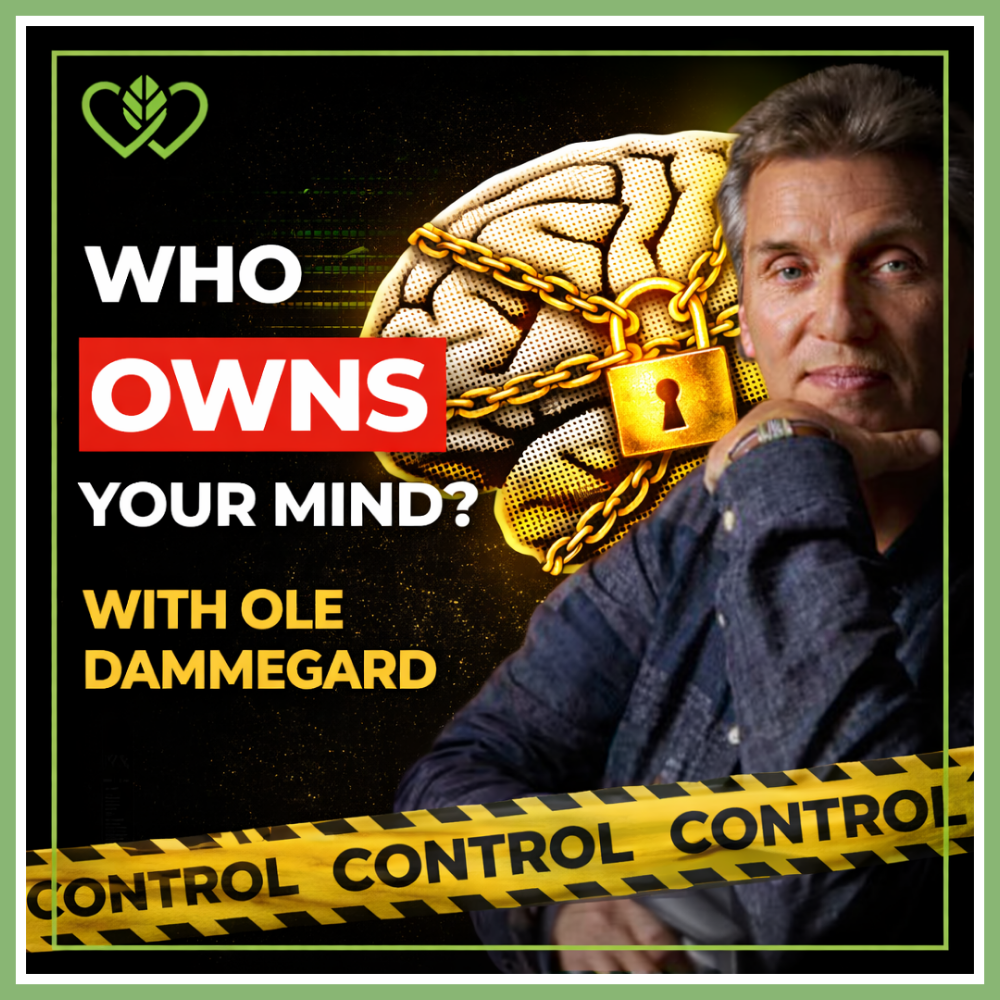
When the World Feels Upside Down: Ole Dammegard on False Flags, Hidden Clues, and the Courage to Say “No”
There are some conversations that you don’t just “record”, you feel them. They land in your body. They rearrange what you thought you knew. And they leave you with important questions afterwards:
How can any of us make good decisions in our lives… if the narrative we’re being guided by is false?
That’s where today’s episode takes us.
I’m so happy to welcome back someone I can now genuinely call a friend, Ole Dammegard. If you’re new here, Ole is a truth seeker, a code breaker, and (I think this matters more than most people realise) a peacemaker. He’s devoted decades of his life to investigating deception at scale, and he’s widely known for his work around false flag events, not as an armchair theory, but as a pattern he’s studied, tracked, and documented with an intensity most people wouldn’t even attempt.
And honestly, I keep inviting Ole back for two reasons.
One: I really like him 😀 he’s human, humble, funny, and grounded in a way that feels rare in this space, and he loves cats!
Two: because what he’s doing is deeply relevant to health…not just political health, but nervous system health, mental clarity, and our ability to stay connected to reality in a world that increasingly seems designed to confuse and fragment us.
When the “truth” you’re living inside is distorted… your decisions get distorted too.
When You See the Manipulation, You Can’t Unsee It
One of the most useful analogies Ole shared right at the start was this:
Imagine your sister starts dating someone, and you begin to notice something is… off. Small lies. Emotional manipulation. A slow attempt to isolate her, reshape her, move her away from everything familiar.
At first, you might think, “Not my business.” You might even tell yourself you’re overreacting.
But then, slowly, it becomes obvious that the information, the energy, and the influence around this person is guiding someone you love into danger.
At that point, staying silent isn’t neutrality, it’s abandonment.
And that, Ole says, is what it’s like when you begin to see through public narratives that don’t add up. You start noticing that the story you’re being fed isn’t simply “a mistake” or “bad journalism,” but a coordinated direction of attention, pulling societies toward fear, control, obedience, surveillance, and dependency.
And once you see that, you can’t just go back to scrolling, snacking, and pretending everything is fine.
Because people get hurt.
And the more you look, the more you realise the damage isn’t accidental.
So… What Is a “False Flag”?
Let’s define it simply, because this term gets thrown around a lot.
A false flag is an event presented to the public as one thing, often with a clear “enemy” assigned, but which, according to investigators like Ole, shows recurring signs of being orchestrated or manipulated to achieve a separate agenda.
Not for drama.
Not for entertainment.
But to shape the emotional and behavioural direction of populations.
And the reason this matters is because if you misidentify the source of a problem, you can never find a real solution.
Ole gave an example that I really liked:
If we’re told the “problem” is Abdul and his homemade bomb… then the “solution” becomes hunting Abdul, blaming Abdul, fearing Abdul.
But if the deeper issue is an engineered operation used to justify surveillance, policy changes, and long-term psychological management through fear… then chasing Abdul keeps you busy while the machinery behind the scenes continues running uninterrupted.
So the question becomes:
Are we responding to reality, or to a staged story designed to steer us?
“They Tell You in Subtle Ways” — The Hidden Clue Principle
One of the most striking parts of this conversation is Ole describing what changed everything for him.
Years ago, he was contacted by someone on the inside, anonymous, but credible enough to reference details that signalled real access. And this person said something Ole couldn’t ignore:
Some of them believe they can reduce karmic responsibility by revealing what they’re going to do, even subtly, because if the public doesn’t react, then the “burden” transfers.
Whether you believe in karma or not, what matters is that THEY do, here is the pattern Ole started to see:
Hidden clues.
Predictive signalling.
Rehearsals.
Foreshadowing.
Symbolism.
Timelines.
Repeated narrative structures.
He describes it like learning a language nobody else knows, grammar, expressions, cues “between the lines.” And once he understood that this pattern was real, he stopped looking elsewhere and started focusing on decoding these clues.
Ole has connected or exposed dozens of events in advance — sometimes months before — by noticing those patterns.
And here’s the part that should shake people awake:
Ole says he’s repeatedly offered to help authorities, repeatedly volunteered to explain his methods, repeatedly said “bring me in.”
And instead of collaboration?
He describes harassment, threats, attacks, and the reality of facing prison time in Sweden, for the same work he’s been publicly recognised for elsewhere.
That contradiction alone should make you stop and think.
Because when the world starts punishing those who expose harm… while rewarding those who spread it… you’re not in a normal system anymore.
You’re in an inverted one.
The Upside-Down World: When Bad Is Good and Good Is Bad
Ole described something I’ve felt for years, but couldn’t always put into words.
That sensation of walking through a world where:
-
good is reframed as dangerous
-
harm is reframed as “for your safety”
-
censorship is reframed as “care”
-
compliance is reframed as “virtue”
-
questioning is reframed as “mental illness”
And for anyone who feels confused, he offered a brutal clarity:
If the world feels upside down… it isn’t because you’re mad.
It’s because the narrative is inverted.
And once you accept that inversion, a very practical strategy emerges:
Start asking:
If they’re banning it, mocking it, discrediting it, or shaming it… why?
What power do you regain when you stop obeying automatically?
Because sometimes the entire spell breaks the moment you calmly say:
No. I’m not doing that.
Not violently. Not hysterically.
Just clearly.
.

“Conspiracy Theory” — The Most Successful Psychological Operation in Modern History
This is important, because it’s the fastest way people get silenced.
Ole explained the historical origins of “conspiracy theorist” as a slur , particularly after JFK, and how the term was weaponised to socially punish curiosity.
But what I found even more interesting is this:
He pointed out how many people can’t even hear the word conspiracy without automatically adding theory in their minds.
That’s conditioning.
That’s branding.
That’s repetition at scale.
And he offered a reframe that’s worth sitting with:
A theory isn’t automatically “a random guess.” In many fields, theory means making something visible, explaining structure, patterns, mechanics.
So if we’re being honest, “conspiracy theory” should mean:
the study that makes conspiracies visible.
And yet, culturally, it’s been flipped into:
“don’t look here.”
Which should tell you exactly why it exists.
The Fear Economy: Trauma, Surveillance, and the “Security Solution”
We also touched on something that feels incredibly relevant to daily life: the way fear is used to justify systems of control.
Ole referenced how “random” violence produces national trauma, and how that trauma is then followed by:
-
increased surveillance
-
expanded security budgets
-
tighter policing powers
-
restrictions sold as protection
-
social compliance sold as safety
And whether you agree with every example Ole mentioned or not, the broader pattern is one we’ve all felt:
When you scare people enough, they will beg for the cage…as long as you call it a shield.

The Church, the Military, and Controlled Opposition
Another thread we explored was the growing visibility of religious movements, ministries, and “faith leaders” being folded into political and ideological agendas.
Ole’s perspective is not about attacking genuine faith (and I want to be clear: I’m not here to shame anyone’s spiritual path). It’s about recognising that large-scale influence structures often use institutions people trust, because that’s the easiest way to bypass critical thinking.
He also spoke about “controlled opposition” , the idea that a source can be mostly accurate, mostly valuable, mostly truth… but still subtly steer people away from the root, or protect certain power structures by omission.
And that’s what makes it dangerous:
If something is 90% true, you’ll defend it with your whole nervous system…and you won’t notice the 10% that redirected you.
The Most Practical Takeaway: You Don’t Need to Solve the Entire Puzzle
This is where I want to ground the conversation, because I know this topic can overwhelm people.
You do not need to understand every operation, every agency, every historical detail to reclaim your sovereignty.
But you do need to reclaim your attention.
You need to notice when you’re being emotionally hijacked.
You need to slow down when a narrative is trying to push you into instant certainty, instant outrage, instant fear, instant division.
And you need to rebuild your relationship with your own inner “yes” and inner “no.”
Because if you can’t say no, you’re not free, you’re just compliant with good aesthetics.
The Beautiful Pivot: Ole’s Retreats and the “SLU” Vision in Bali
I loved where this conversation ended, because it’s not just critique, it’s creation.
Ole shared that, due to ongoing pressures and restrictions, he and his partner Kim are now building something different: retreats in Bali, and a longer-term vision called SLU — a neighbourhood concept rooted in like-hearted, like-minded people who want to live closer to truth, nature, creativity, and community.
Not a gated cult.
Not a fantasy escape.
Not a utopia.
But a real-life attempt to build something healthier than the systems we keep complaining about.
And to me, that’s the real point.
At some stage, awareness must become embodiment.
And embodiment must become action.
Even if that action is small , changing how you consume media, how you speak, who you trust, where you place your money, how you build your resilience, and how you connect with people in the real world.
Because the more decentralised we become , emotionally, mentally, practically, the harder we are to steer.
How to Listen + Links
🎧 Listen to the full podcast episode here: AND PLEASE LEAVE A COMMENT or REVIEW
SPOTIFY
📩 Ole’s website + work:
https://www.lightonconspiracies.com
🌿 Retreat info (Bali): and use discount code LAUNCH for 100-euro discount
CLICK HERE
🏡 SLU / neighbourhood vision info:
https://lightonconspiracies.com/welcome-to-selalu-a-neighbourhood-for-light-minded-friends/
If you feel inspired by this episode, please share it with someone you care about. That’s how this grows — not through algorithms, but through people passing truth hand to hand.
And above all…
Stay curious. Stay free.