


The Problem Beneath the Problem
Why intelligent, capable professionals stay stuck—and why the breakthrough is rarely where they expect it to be.
Have you ever found yourself wondering why, despite everything you’ve learnt, achieved and experienced, there still seems to be a gap between where you are and where you know you’re capable of being?
Most of the professionals I work with aren’t lacking ambition, intelligence or commitment. They’ve built successful careers, taken on leadership responsibilities and invested heavily in their own development. They’ve read the books, attended the courses and genuinely want to keep growing. Yet many still describe the same frustration. They know what they should be doing, but for some reason they don’t always do it consistently. They find themselves putting off important conversations, overthinking decisions, delaying opportunities or repeating behaviours they promised themselves they would change.
It’s easy to assume the answer is simply to become more disciplined, more organised or more confident. Those explanations seem logical because they’re the behaviours we can see. The difficulty is that behaviour is rarely where the real story begins.
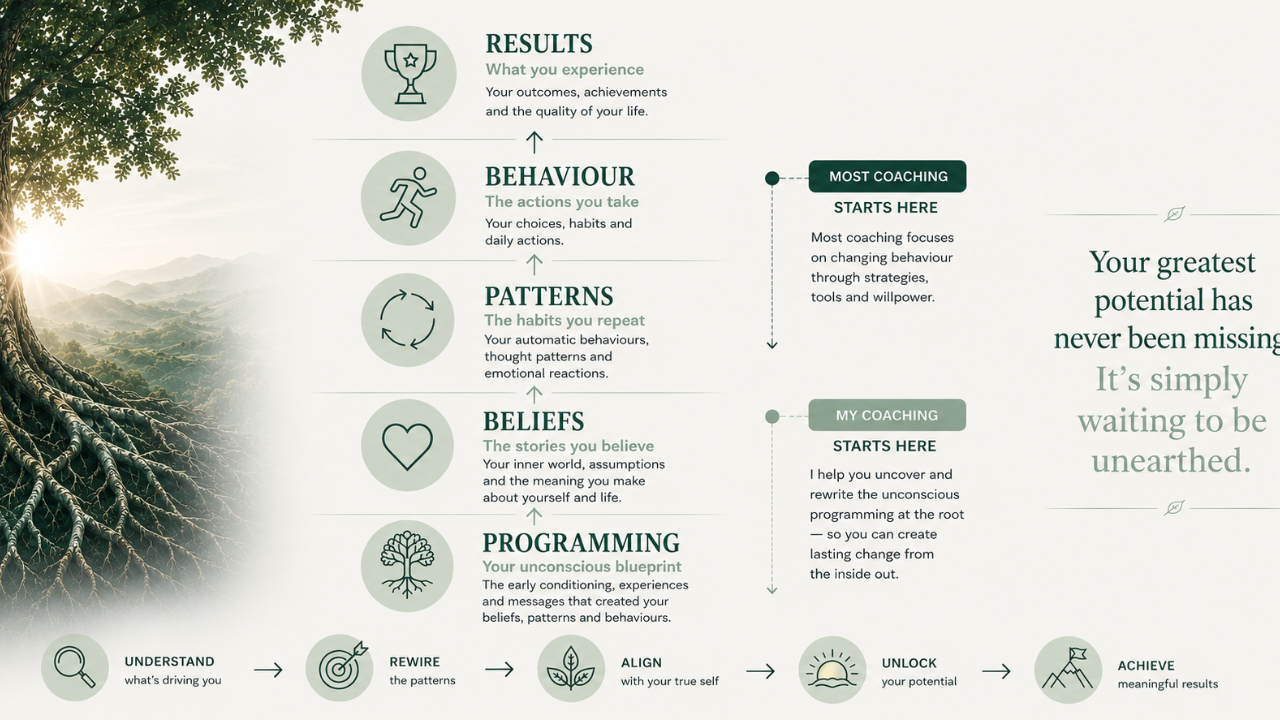
One of the biggest lessons I’ve learnt over the past twenty years is that the problem people bring to coaching is rarely the problem that creates the greatest breakthrough. The issue someone wants to fix is often genuine, but it’s usually only the symptom that’s become impossible to ignore. Beneath that visible behaviour is often a pattern that’s been influencing decisions, relationships and performance for many years.
The visible problem is rarely the real problem.
Think about it for a moment. If someone struggles with confidence, is confidence really the issue? If someone procrastinates, is discipline really what’s missing? If someone constantly feels overwhelmed, is poor organisation really the cause? Sometimes the answer is yes. More often than not, however, those behaviours are simply pointing towards something much deeper that hasn’t yet been recognised.
A good analogy is the warning light on the dashboard of your car. The light itself isn’t the problem. It’s simply alerting you that something underneath the bonnet needs your attention. Covering the warning light doesn’t repair the engine, and continually trying to change a behaviour without understanding what’s driving it often produces the same result. You might experience short-term improvement, but before long the familiar patterns begin to return.
This is one of the reasons lasting change can feel so frustrating. We naturally focus on the behaviour because it’s obvious, measurable and feels easier to fix. We buy another diary, attend another productivity course, read another leadership book or promise ourselves that next week we’ll be more disciplined. Those things can all be helpful, but if they’re addressing the symptom rather than the cause, the improvement is often temporary.
So why does this happen?
The reason is simple: none of us experiences the world completely objectively.
Every one of us sees life through a unique lens shaped by our experiences, our upbringing, the environments we’ve worked in, the relationships we’ve had and the beliefs we’ve developed along the way. That lens influences far more than most of us realise. It shapes how we respond to pressure, how we communicate, how we lead, how we interpret feedback and even how we see ourselves. Over time those interpretations become familiar ways of thinking, and eventually they become so automatic that we stop questioning them altogether.
That’s why two people can experience exactly the same situation and walk away with completely different conclusions. One sees opportunity. Another sees risk. One receives constructive feedback and feels motivated to improve. Another hears exactly the same words and quietly concludes they’re not good enough. The event hasn’t changed. The meaning attached to it has.
This is where coaching becomes so much more than improving performance.
I’ve found that when people begin to understand the patterns influencing their decisions, entirely different conversations emerge. Someone who believes they’re struggling with organisation may discover that organisation was never the real issue. They were avoiding the visibility that success would bring. Someone convinced they lack confidence may realise they’ve spent years carrying a belief that speaking up isn’t safe. Another person may continually put everyone else’s needs ahead of their own, not because they lack discipline, but because somewhere along the way they learnt that looking after themselves should always come last.
On the surface, those look like completely different problems. Beneath the surface, they’re all examples of intelligent people responding to patterns they never consciously chose. Once those patterns become visible, something incredibly important happens. They regain choice. Instead of automatically repeating the same responses, they begin making decisions that are aligned with the person they want to become rather than the patterns they’ve always followed.
This is also why I’ve never believed you can separate professional performance from the rest of your life. You don’t leave your subconscious at the office door. The person who walks into a board meeting is the same person who walks through their own front door that evening. If you struggle with boundaries at work, there’s often a similar pattern elsewhere. If you’re constantly trying to please colleagues, it’s worth asking whether that pattern also exists in your personal relationships. Likewise, if your health, wellbeing or relationships are suffering, it’s almost impossible for that not to influence your judgement, leadership and performance.
For that reason, I’m not interested in coaching careers in isolation. I’m interested in understanding the person creating that career. When people understand themselves more clearly, the benefits rarely stop at work. They become better leaders because they become better decision-makers. They communicate more effectively because they’re no longer driven by fear of conflict or the need for approval. They look after their health because they recognise that sustained performance depends upon it. In short, they begin building a life where their actions are finally aligned with their ambitions.
That’s why I created Freedom From Self-Sabotage.
Not because I believe successful people need more information. In fact, most of the professionals I work with already know far more than they give themselves credit for. What they’re often missing isn’t another strategy. It’s the opportunity to step back, recognise the patterns shaping their behaviour and understand why those patterns made perfect sense at one stage of their life, but may no longer serve the future they’re trying to create.
My role isn’t to tell people who they should become.
It’s to help them uncover the person they’ve always been capable of becoming.
That doesn’t happen through motivation alone, nor through working harder or collecting more qualifications. It happens by developing a deeper understanding of yourself so that your daily choices naturally begin supporting the life you’re trying to build.
Perhaps that’s why the question I ask most often isn’t, “How do we fix this behaviour?”
It’s much simpler than that.
“What if this isn’t the real problem?”
Once you’re willing to ask that question, everything else begins to change.
Book a Complimentary Discovery Call
If any part of this article resonated with you, perhaps the most valuable next step isn’t finding another strategy—it’s taking the opportunity to explore whether you’ve been trying to solve the wrong problem.
A Discovery Call isn’t a sales conversation. It’s an opportunity for us to step back, explore the challenges you’re facing and begin identifying the patterns that may be holding you back from the results you know you’re capable of achieving.
Sometimes the greatest breakthrough isn’t learning something new.
It’s seeing yourself differently.
You can book here.