
We are moving into a world where wireless networks may no longer simply connect devices.
They may increasingly be designed to sense the environment around them too.
That is not science fiction. It is already being discussed openly within the telecommunications industry under the development of 6G.
And whether you feel excited, sceptical, concerned or curious, I think this is a conversation we need to have calmly, intelligently and without fear.
Technology does not just shape convenience. It shapes biology, behaviour, nervous systems, sleep, attention, privacy, homes, animals, plants and the way we live.
So the question is not simply:
“Will 6G be faster?”
The better question is:
“What kind of world are we building — and have we consciously agreed to it?”
What Is 6G Being Designed To Do?
Most people think each new wireless generation simply means faster internet. We have been told:
1G gave us analogue voice calls.
2G brought texting.
3G enabled mobile internet.
4G changed streaming and app-based living.
5G increased speed, device density and low-latency connection.
But 6G appears to be aiming at something broader again.
Not just communication.
- Sensing.
- Artificial intelligence.
- Positioning.
- Digital twins.
- Immersive environments.
And something called ISAC — Integrated Sensing and Communication.
In simple terms, this means the same wireless infrastructure used to transmit data may also be used to detect presence, movement and environmental changes.
That may include applications such as:
- detecting human presence
- movement tracking
- posture or gesture recognition
- fall detection
- indoor positioning
- environmental monitoring
- sensing objects or people without cameras or wearable devices
So this is not just “better phone signal”.
It is the possibility of the network becoming a sensing layer across physical space.
And that should make every thinking person pause, and start to ask some serious questions.
Once a system can connect, sense, track, analyse and feed data into artificial intelligence, we are no longer just talking about convenience.
We are talking about autonomy, privacy, surveillance, health, consent and what it means to live in a truly biological world.
The Apple AirPods Question
This is where it becomes even more interesting.
Apple has already filed patents around earbuds with biometric sensors. Some patent language describes earbuds capable of measuring biological parameters using sensors positioned against the ear.
Other reports have discussed Apple patents for AirPods-style devices that could potentially measure biosignals such as heart activity, muscle signals, eye movement or even brain-related electrical activity.
Now, a patent does not mean a product definitely exists or will be released.
But patents do show direction of travel.
And the direction of travel is clear:
Technology is moving closer to the body.
Not just in our hands.
- In our ears.
- On our wrists.
- Against our skin.
- Potentially monitoring biology in real time.
Again, that may have benefits.
Health monitoring could help some people.
Emergency detection could save lives.
But the question remains:
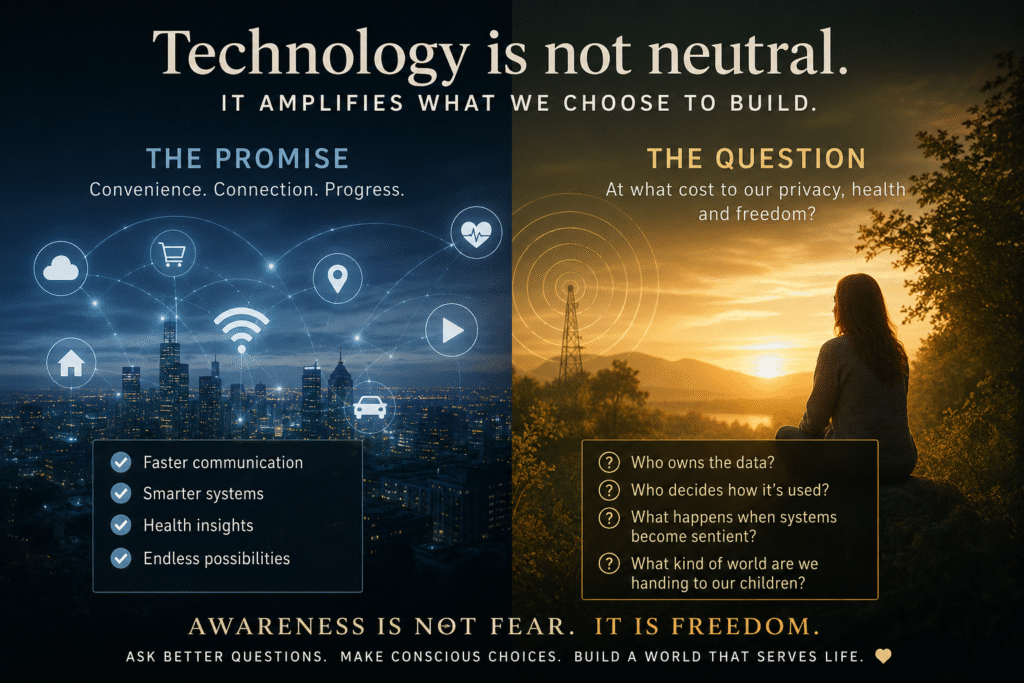
- Who owns the data?
- Who accesses it?
- Who interprets it?
- Can it be shared with insurers, employers, governments, platforms or AI systems?
- Can “health protection” become another excuse for monitoring?
We saw during COVID how quickly health language can be used to justify tracking, restriction, testing, surveillance and compliance.
So no, I do not think it is extreme to ask questions now.
I think it is responsible.
Does 6G Penetrate Deeper Into The Body?
This is an important point to get right.
Some people say 6G frequencies will penetrate deeper into the body.
From the physics I have seen, higher-frequency millimetre-wave and terahertz signals generally penetrate less deeply than lower-frequency radio waves. They are more readily absorbed by surfaces such as skin, eyes, clothing, water and obstacles.
So the concern may not be “deeper penetration” in the simple way people often describe it… or we may not be seeding the real data?
The concerns may be different:
- more infrastructure
- more devices
- more beam-forming
- more continuous exposure
- more sensing capability
- more data collection
- more interaction with skin, eyes and surface tissues
- more cumulative biological load in an already overstimulated world
That distinction matters.
If we want to be taken seriously, we need to ask better questions, not just repeat dramatic claims.
The Health Conversation Is Not Finished
One of the biggest problems with EMF conversations is that people are usually pushed into two extremes.
Either:
“There is absolutely no risk.”
Or:
“Everything is catastrophic.”
But biology is rarely that simple.
There is ongoing scientific debate (not nearly enough) around radiofrequency exposure, including questions about oxidative stress, sleep, fertility, nervous system effects, long-term exposure patterns and how emerging frequencies may affect living systems.
Official bodies generally say current safety limits are designed to protect against established adverse effects, especially heating.
But many independent researchers continue to ask whether that is enough.
- What about chronic low-level exposure?
- What about children?
- What about animals?
- What about insects, birds and species that navigate through natural electromagnetic fields?
- What about people who already have high toxic load, poor sleep, chronic stress, nervous system dysregulation or illness?
- What about the cumulative effect of phones, Wi-Fi, Bluetooth, routers, towers, smart meters, wearables, electric vehicles, smart homes and future sensing networks?
This is not a niche exposure anymore.
It is the background environment.
When something becomes the background environment of daily life, it deserves serious scrutiny.
The Nervous System Question
Many people today describe feeling:
- wired but exhausted
- unable to switch off
- mentally scattered
- sleep deprived despite being tired
- overstimulated
- hypervigilant
- constantly “on”
Of course this is multi-factorial.
- Food matters.
- Light matters.
- Stress matters.
- Trauma matters.
- Movement matters.
- Water matters.
- Social pressure matters.
However, I do not think we should automatically dismiss the possibility that artificial electromagnetic environments may be adding to the total stress load for some people. In fact I am sure it is a major contributor. Plenty of studies show this to be the case.
Especially when many individuals report feeling noticeably different when they:
- switch Wi-Fi off at night
- remove phones from the bedroom
- reduce Bluetooth exposure
- spend more time in nature
- sleep away from devices
- create calmer, lower-stimulation spaces
Sometimes biology responds before the official language catches up.
Children, Animals & The More Sensitive Systems
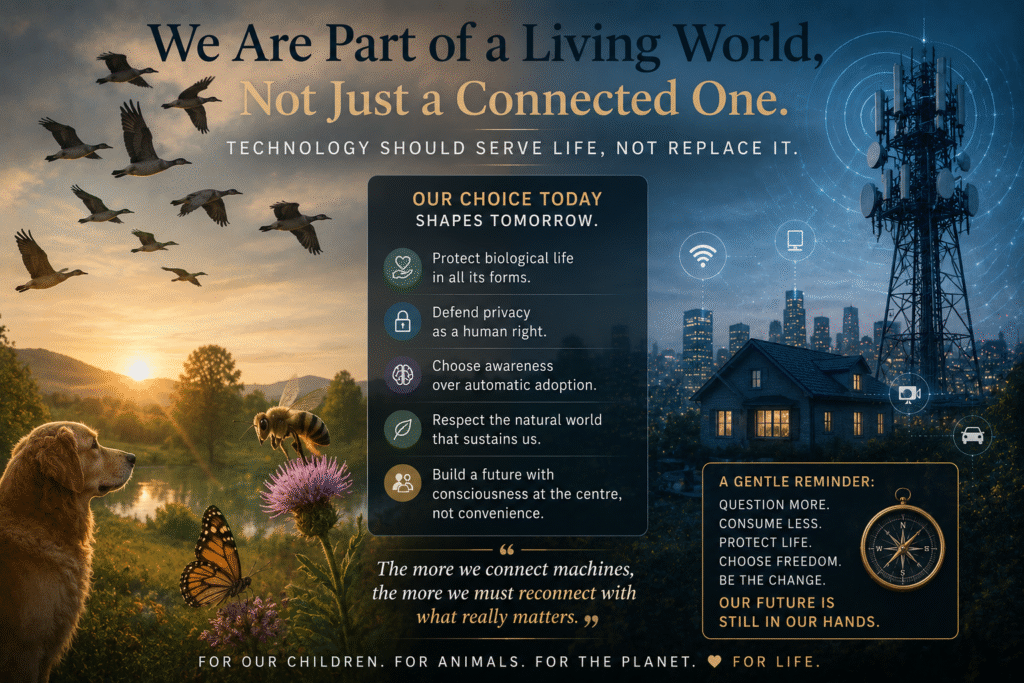
This is the part that concerns me most – when we consider children and animals.
Children’s nervous systems are still developing.
Animals often spend far longer inside our home environments than we do, and are very sensitive to frequencies and magnetic changes. If elephants can reportedly move to higher ground before a tsunami arrives, migrating birds can navigate across continents using the Earth’s magnetic field, and countless animals seem able to detect approaching storms before we can, is it really unreasonable to ask whether increasingly artificial electromagnetic environments might also influence the species sharing our planet?.
Birds, bats, insects and many species rely on subtle environmental signals to navigate and survive.
- And any animal guardian knows this:
- Animals often sense things before we do.
- They sense storms.
- They sense earthquakes.
- They sense emotional shifts.
- They sense danger.
So why would we assume they are completely unaffected by an increasingly artificial electromagnetic environment?
That does not mean we blame every symptom on EMFs.
But it does mean we look at the whole terrain.
- Food.
- Water.
- Light.
- Stress.
- Chemicals.
- Sleep.
- Air quality.
- Noise.
- Wireless exposure.
- Connection to nature.
Biology does not experience these things separately.
It experiences the total environment.
The Bigger Question
I do not believe fear helps, but blind acceptance does not help either.
Many technologies have been rolled out long before long-term biological effects were fully understood.
That does not mean all technology is bad.
It means innovation often moves faster than wisdom.
And perhaps the most important question is this:
Are we conscious participants in the world being built around us?
Or are we simply adapting to every new layer of stimulation, surveillance and artificiality because we have been told there is no choice?
Because there is always choice.
We may not be able to stop every tower, every device or every rollout.
But we can still make choices inside our own homes.
Practical Things You Can Do
You do not have to live in fear.
You do not have to move to a cave.
But you can reduce unnecessary exposure.
Simple steps include:
- turn Wi-Fi off overnight
- hardwire where possible
- keep phones away from the body
- use Airplane Mode when you can
- avoid sleeping beside phones
- reduce Bluetooth use
- avoid unnecessary smart devices in bedrooms
- spend more time outdoors
- support circadian rhythm
- prioritise deep sleep
- create low-stimulation spaces for children and animals
- build biological resilience through food, movement, sunlight, water and nervous system regulation
- I also personally use EMF-supportive tools in my own home, including ATOM Lab devices and FLFE (you can try this completely free), because I believe environment matters.
Not just emotionally.Biologically.
In a world becoming more saturated with artificial signals, I think creating a calmer, more coherent home environment is one of the most important things we can do.
Final Thoughts
6G may not be fully rolled out until around 2029, 2030 or beyond…or it may be much sooner.
The bigger conversation is already here.
How do we advance technologically without disconnecting from biology?
How do we protect privacy when devices are moving closer to the body?
How do we protect children and animals who cannot consent?
How do we prevent health monitoring becoming behaviour monitoring?
How do we keep asking questions before systems become so normalised that nobody remembers they were optional?
I am not anti-technology.
I am pro-consciousness.
Pro-biology.
Pro-choice.
Pro-natural rhythms.
Pro-human and animal wellbeing.
I think the future belongs to those who are willing to ask better questions before blindly accepting the next upgrade.
Because knowing better is not enough.
We have to live better too.
References
- https://ehtrust.org/
- The ITU says IMT-2030, also known as 6G, includes six usage scenarios, including AI and communication and Integrated Sensing and Communication. (ITU)
- The ITU/5G Americas IMT-2030 overview describes sensing as the ability to detect presence and movement of active devices and passive objects, with positioning targets discussed in the 1–10 cm range.
- Ericsson describes 6G as expected for commercial markets in the early 2030s and as an “intelligent fabric” involving AI, cloud and mobile infrastructure. (ericsson.com)
- Qualcomm says 6G standards are expected around 2029/2030 and describes 6G as integrating AI, sensing, digital twinning and spatial perception. (qualcomm.com)
- Apple patent documents describe earbuds with biometric sensors able to measure biometric parameters when positioned against the ear. (Google Patents)
- A review on terahertz communications for 6G discusses future 2030s applications and the move toward very high-frequency spectrum, including tens of GHz to 1 THz. (ScienceDirect)
- ICNIRP’s 2020 RF guidelines cover 100 kHz to 300 GHz and state they are intended to protect against adverse health effects from RF EMF exposure. (icnirp.org)
- The US National Toxicology Program carried out two-year studies in rats and mice exposed to cell-phone-type RF radiation, with findings still debated for human relevance. (ntp.niehs.nih.gov)