
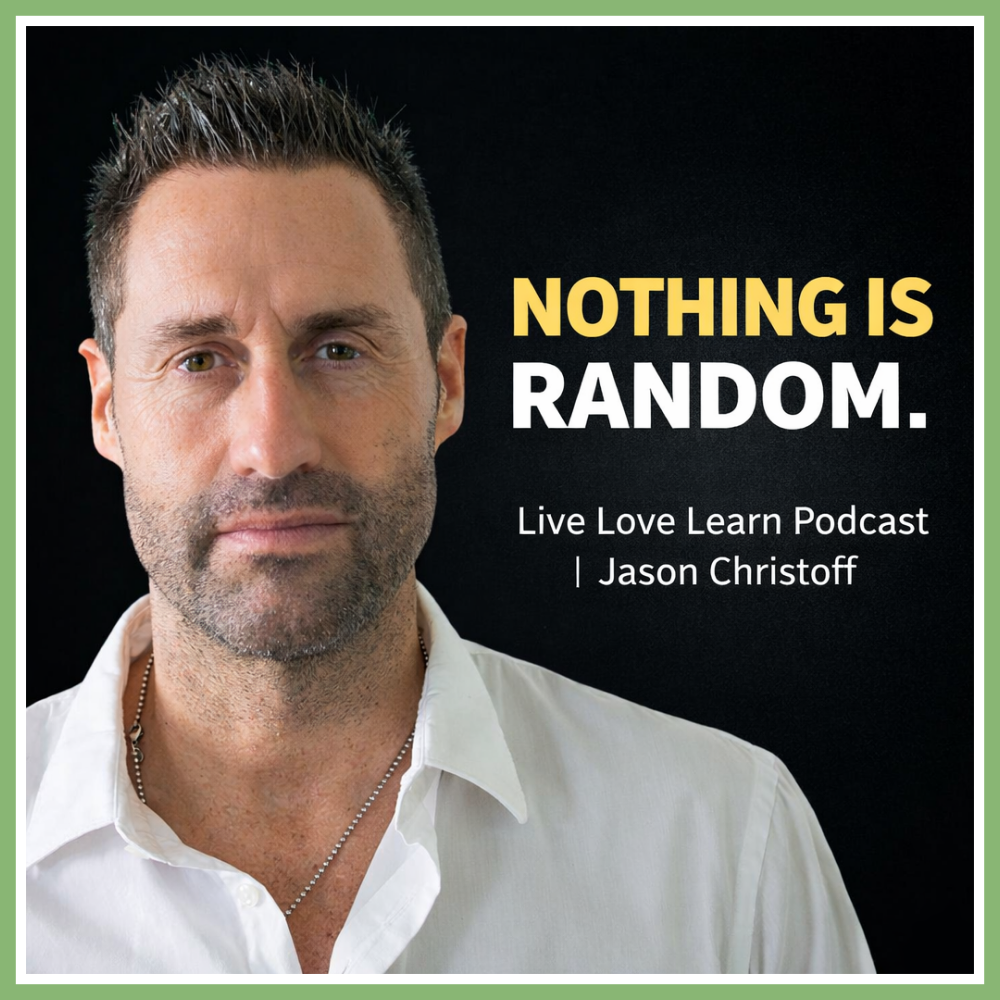
Deprogrammed: Why High Emotion Makes Us Suggestible (And How To Get Your Mind Back)

There’s a line Jason Christoff said in this episode that kept echoing in my mind long after we stopped recording:
“You’re not easily mind controlled unless you’re highly emotional.”
And at first, that can feel confronting, because most of us like to believe we’re rational, independent thinkers. We like to believe we’d spot manipulation a mile off. But if you’ve ever noticed how differently you think when you’re calm versus when you’re panicked, outraged, anxious, or swept up in a collective mood, then you already know what he means.
When we’re emotionally spiked, the nervous system is scanning for safety, not truth. It wants relief. It wants certainty. It wants someone to tell us what’s going on and what to do next. And in that state, we are far more suggestible than we realise, not because we’re “stupid,” but because we’re human.
This is exactly why I wanted Jason back for another episode in my Deprogrammed series.
In our first conversation (I’ll link it below), we explored the link between trauma and control, and how unresolved stress patterns can keep people locked into fear, obedience, and dependency. But this time we went deeper, not in a “theory” way, but in a “how does this show up in real life?” way, with examples that force us to sit up and ask: Where am I being pulled emotionally, and what does that make me willing to believe?
Most of us don’t want to spend our lives being played. We want to be awake enough to participate in our own lives, and strong enough to make choices that are actually ours.The problem is when we don’t even realise we are being played…
A quick hello (and why this matters)
For anyone new here, welcome. I’m Catherine Edwards, a Holistic Biologist, and I work with humans and animals. That might sound like an odd pairing, but it’s actually been one of the most helpful lenses for seeing the world clearly, because when you work with animals you learn very quickly that behaviour and health issues are often most affected by environment, nervous system, and patterning, not “personality.” You learn to look for the why, not just the surface.
When you start seeing how animals respond to stress, pressure, fear cues, and group energy, you can’t un-see how the same dynamics show up in humans too, especially at scale.
Jason is an expert in psychological reprogramming and mind control. He teaches people all over the world to recognise subconscious manipulation, whether it’s coming through media, education, entertainment, or politics. He’s spoken in high-level rooms (including governmental settings), but what I value most is his willingness to bring everything back to something practical:
What does manipulation look like day to day? How does it work in the body? And what does a person actually do about it?
The point Jason keeps coming back to: emotional hijack = suggestibility
One of the strongest threads in this conversation was the idea that high emotion narrows perception. Jason explains it in a way that’s simple but unsettling: when you’re emotionally flooded, you don’t have the same access to your rational, logical brain. You become more fixated. More reactive. More easily guided toward a “single point of attention.”
And that “single point of attention” is where suggestion gets planted.
He compares it to hypnosis: it doesn’t always look like someone swinging a watch in front of your face, but the mechanism is similar. Your attention is captured, your nervous system is activated, and suddenly the mind becomes more pliable than you’d like to admit.
That’s why, in his view, modern control doesn’t need chains and cages. It needs screens, headlines, short clips, constant outrage cycles, and a population that stays emotionally unstable enough to be steered.
Whether you agree with every example he gives or not, the psychological principle underneath is worth sitting with:
When you’re emotionally “up,” you’re easier to program. When you’re emotionally “down” you’re easier to direct. Either way, your nervous system becomes the target.

Why history matters — even when history has been rewritten
We also touched on something many people feel but rarely say: a lot of what we’ve been taught as “history” doesn’t feel clean anymore. It feels curated. Edited. Presented in a way that supports a particular worldview, and if you only ever learn the version you’re allowed to learn, you end up living inside someone else’s storyline.
Jason’s point here was interesting: even if parts of history have been corrupted or rewritten, you can still do what detectives do. You can look at patterns, symbols, structures, incentives, and outcomes, and start asking better questions about why things happen, not just what happened.
That word “why” came up again and again.
So many people can now sense that something is off, but sensing that something is off isn’t the same as understanding what’s driving it.
And if you don’t know what’s driving it, you end up reacting to the surface theatre, while the deeper mechanics keep running.
The trap of personality politics (and why it’s so effective)
We then moved into one of the most emotionally charged areas: modern politics and “cult of personality.”
Jason’s view is blunt: if you can get people to emotionally attach their identity to a public figure, you don’t just win their attention , you win their loyalty. And once loyalty is secured, questioning becomes psychologically painful, because questioning the figure feels like questioning the self.
It’s one of the reasons people can be presented with evidence that challenges their belief, and still refuse to look, not because they’re incapable, but because the nervous system registers it as threat. If I’m wrong, what does that say about me? If I’m wrong, who am I? If I’m wrong, where do I belong?
That’s not an intellectual dilemma. That’s a belonging dilemma.
And belonging is one of the deepest human drivers there is.
Jason uses examples from the political world to illustrate how quickly public focus can be redirected by an emotionally loaded event, a new “enemy,” or a dramatic headline. Again, you may or may not share his conclusions, but the structure he’s describing is something you can watch in real time:
-
create emotional spikes,
-
give the mind a simple story,
-
offer a hero or villain,
-
and keep the population cycling between outrage and relief.

Strength is the one thing they can’t sell you
One of my favourite parts of this conversation was when we shifted away from what “they” are doing, and back to what we can do.
Jason made a point I deeply agree with, even from a purely biological perspective: strong adults are harder to control than weak adults, and weakness isn’t just physical, it’s psychological.
He talked about how older cultures understood rites of passage, discomfort, discipline, and personal responsibility as part of becoming an adult. Not cruelty for cruelty’s sake, but challenge as a necessary force to move into adulthood. Someone who has learned to regulate themselves through stress, to recover from failure, and to build competence through repetition is not easily bullied by group pressure.
Whereas someone who has been protected from discomfort, rewarded for fragility, and trained to outsource responsibility will naturally seek safety in the herd, and herd-dependency is incredibly easy to manipulate.
This connects to so many modern issues, from health to identity to social media behaviour:
If you don’t build inner strength, you will borrow strength from whatever group feels safest , even if that group is being steered.
“It’s not about perfection — it’s about progress”
Toward the end, Jason shared something I think people really need to hear: getting your power back is not about becoming perfect overnight. It’s about stacking small, real choices until you’re living from a different baseline.
He talked about his non-negotiables: clean water, mostly organic food, limiting alcohol and caffeine, training his body, hardwiring his computer, reducing exposure where he can, and he framed it in a way I appreciated:
Not as “look how disciplined I am,” but as this is how you reclaim agency in a world that profits from your weakness.
And that’s the deeper invitation of this episode.
Not to live in paranoia.
Not to obsess over every headline.
Not to spend your life in endless argument.
But to start living in a way that makes you harder to manipulate, because you’re calmer, clearer, and more internally anchored.

The real question this episode asks you
If you take nothing else from this conversation, take this:
Where in your life are you being pulled into high emotion, and what does that make you willing to believe, excuse, buy, support, or comply with?
Because that’s the doorway.
And once you see it, you can’t un-see it.
Listen to the full episode
This blog is only a snapshot of what we covered, and honestly, the tone of the conversation matters as much as the content, because Jason doesn’t speak like someone trying to “perform.” He speaks like someone trying to wake you up without soothing you.
If you want the full context, examples, and practical tools we discussed, go and listen to the full episode here:
Playlist Of My Other interviews with Jason Christoff (More to come)
If it lands for you, share it with someone who you know is stuck in fear, confusion, or constant emotional reactivity, not to “convince” them of anything, but to give them a new lens.
And as always: stay curious, and stay free.
-
Guest: Jason Christoff
-
Series: Deprogrammed
-
Jason’s email list: info@jchristoff.com
-
Documentary: Planet Mind Control (Jason mentions release timing in the episode)
-
Previous episodes with Jason: Watch here